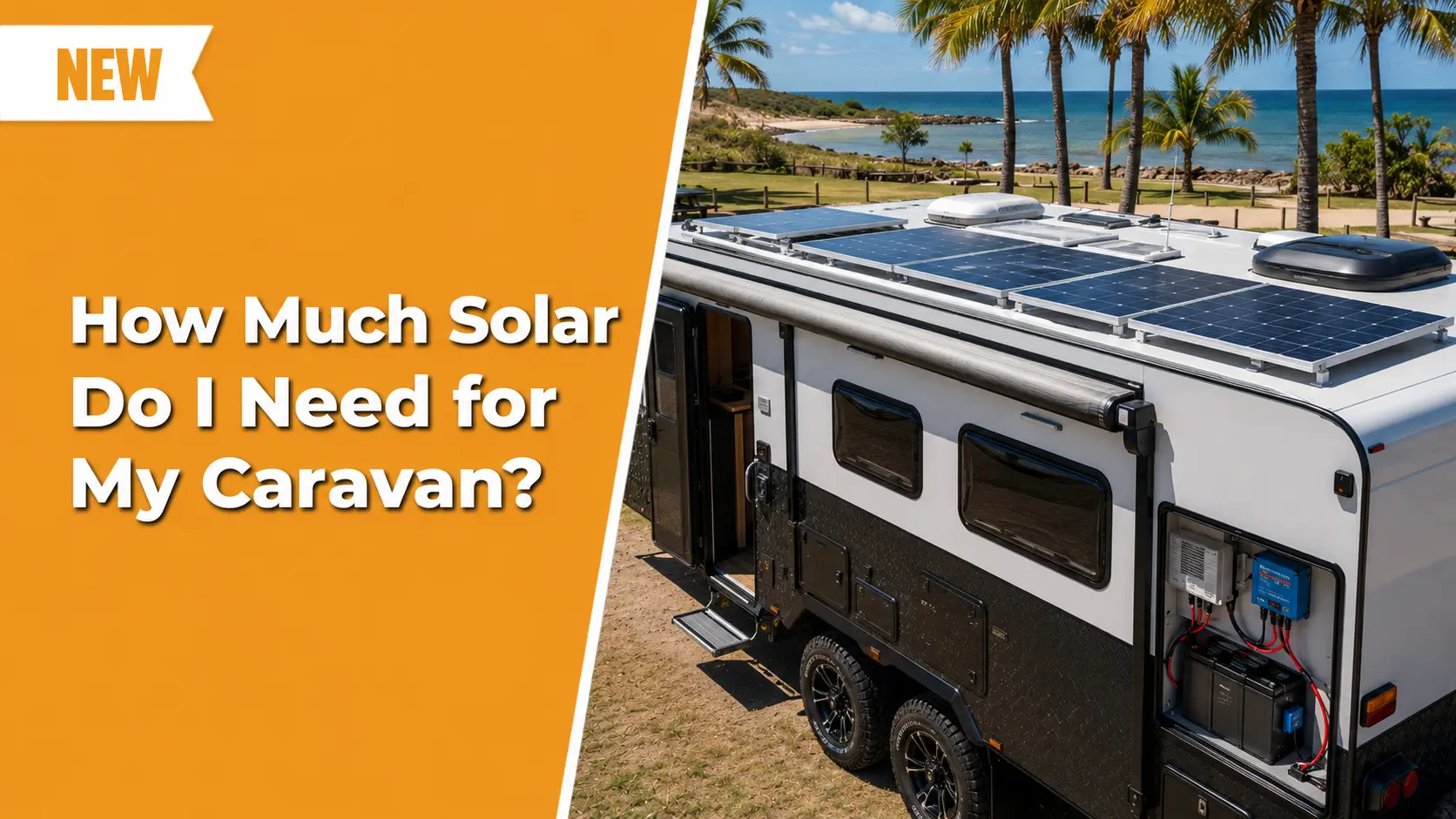
If you are wondering, “How much solar do I need for my caravan?”, the honest answer is: enough to replace the power you use each day, with a reasonable allowance for cloudy weather, heat, shade and system losses.
For many Australian caravans, a practical system may fall between 300W and 800W, but panel wattage is only one part of the answer. Battery capacity, charger sizes, roof space, travel habits and appliances must all work together. This guide will help you calculate your caravan solar requirements and avoid a system that still leaves you short of power.
Start With How You Actually Use Your Caravan
Two caravans that look almost identical can need completely different solar systems. One owner may stay in powered caravan parks and only want solar as a backup. Another may free camp for a week while running a fridge, lights, fans, laptops, Starlink and a coffee machine.
Before choosing panels, ask:
- How many days do you want to camp without connecting to 240V power?
- Do you travel mainly in sunny areas or during winter and wet weather?
- Will your fridge run on 12V, gas or 240V?
- Will you use an inverter for household appliances?
- Do you want to run air conditioning from batteries?
- Will alternator charging or a generator support the solar system?
- How much unshaded roof space is available?
If your caravan has a three-way absorption fridge, its 12V mode is generally intended for use while travelling and can draw substantial current. It should not be treated like an efficient 12V compressor fridge when calculating stationary off-grid use. Check the refrigerator manufacturer’s operating instructions and include the way you will actually run it in your energy budget.
Your goal is not simply to fit the largest panel array possible. It is to build a balanced caravan solar and off-grid power system that suits the way you travel.
Step 1: Calculate Your Daily Power Use
The most reliable way to size caravan solar is to create a daily energy budget. List every electrical item, its power consumption and how long you expect to use it each day.
For a 12V appliance, calculate amp-hours using:
Daily amp-hours = appliance amps × hours used per day
If the appliance is rated in watts, calculate watt-hours:
Daily watt-hours = appliance watts × hours used per day
As a rough example, your daily use might include:
- 12V compressor fridge: 600Wh
- Lights: 60Wh
- Water pump: 30Wh
- Phones and tablets: 100Wh
- Fans: 120Wh
- Television: 120Wh
- Laptop: 180Wh
That totals approximately 1,210Wh, or 1.21kWh per day. At a nominal 12V, that is roughly 101Ah before allowing for conversion and system losses.
Step 2: Convert Daily Consumption Into Solar Panel Wattage
Solar panels are rated under standard test conditions, but caravans operate in the real world. Panel temperature, cloud, shade, dust, wiring, roof angle and charger efficiency all affect the energy that reaches your battery.
A useful starting calculation is:
Required solar watts = daily watt-hours ÷ peak sun hours ÷ system-efficiency factor
If your caravan uses 1,210Wh per day, receives an average of five useful peak sun hours and you use a conservative efficiency factor of 0.75:
1,210 ÷ 5 ÷ 0.75 = approximately 323W
That is the mathematical minimum for that example under those conditions. In practice, you may choose 400W or more to provide a buffer for changing weather and heavier-use days.
Peak sun hours are not the same as daylight hours and vary by location, season and conditions. A system that performs comfortably in summer may struggle during winter or overcast weather.
What Size Caravan Solar System Is Commonly Needed?
These examples are a general starting point, not a substitute for a proper load assessment.
200W to 300W: Light or Occasional Use
This may suit travellers who mainly use powered sites or have very modest 12V needs. It can support lights, a water pump, phone charging and other small loads, particularly when the fridge runs on gas while camped. The available margin may be limited in poor weather.
400W to 600W: Moderate Off-Grid Use
This range can suit many couples using a compressor fridge, lights, pumps, fans, television and device charging. It may also support limited inverter use, depending on the appliances and battery bank. Careful energy management is still important.
700W to 1,000W or More: High-Demand Touring
A larger array may be appropriate for extended off-grid travel, larger refrigeration loads, Starlink, work equipment or frequent inverter use. Running high-wattage appliances such as induction cooktops, microwaves, kettles or air conditioners requires much more than adding panels: the battery bank, inverter, cables, fuses, chargers and thermal management must all be designed for the load.
If you are planning substantial 240V use, read about how a lithium battery system and inverter work together.
Your Battery Bank Matters Just as Much as Your Panels
Solar panels generate energy; batteries store it for use at night, in shade or during bad weather. If the battery bank is too small, a large solar array cannot make up for inadequate overnight storage. If the solar array is too small, a large battery bank may never recharge properly while you are off-grid.
A simple starting point is to decide how many days of usable energy you want in reserve. If you use about 100Ah per day and want two days of autonomy, you need at least 200Ah of usable capacity—and preferably a sensible reserve for poor weather and unexpected loads. Usable capacity is not always the same as the battery’s advertised capacity.
Usable capacity depends on the battery type, manufacturer requirements, temperature, age and discharge limits. Lithium batteries can generally provide more usable energy for their rated capacity than traditional lead-acid batteries, but the entire charging system must be compatible. Our guide to AGM versus lithium caravan batteries explains the key differences.
A well-designed caravan battery management system also helps coordinate charging, protect equipment and give you clearer information about the battery’s state of charge.
Do Not Forget Inverter Loads
An inverter turns stored 12V DC energy into 240V AC power. It does not create extra energy. In fact, conversion involves losses, so an appliance can place a substantial load on the battery.
For example, a 1,500W appliance used for only ten minutes consumes about 250Wh before allowing for inverter losses. Use several high-powered appliances each day and the solar requirement rises quickly.
There are two separate questions to answer:
- Can the inverter supply the appliance’s running and startup demand?
- Can the battery, cabling and charging system provide and replace that energy safely?
This is why sizing solar from a list of panels alone can be misleading. The complete electrical system needs to be assessed.
Why “Just Add Another Panel” May Not Solve the Problem
If your batteries are regularly going flat, insufficient panel wattage is only one possible cause. The real issue may be:
- shading or dirty panels
- a failed or undersized solar controller
- poor connections, voltage drop or damaged cabling
- incorrect charger settings
- a battery that has lost capacity
- an inaccurate battery monitor
- unexpected standby loads
- daily consumption that is higher than expected
A professional assessment should compare energy use with generation, test the batteries and charging performance, inspect the installation and check whether the components work together correctly. Our article on understanding caravan batteries and solar systems provides further background.
Australian Installation and Safety Requirements
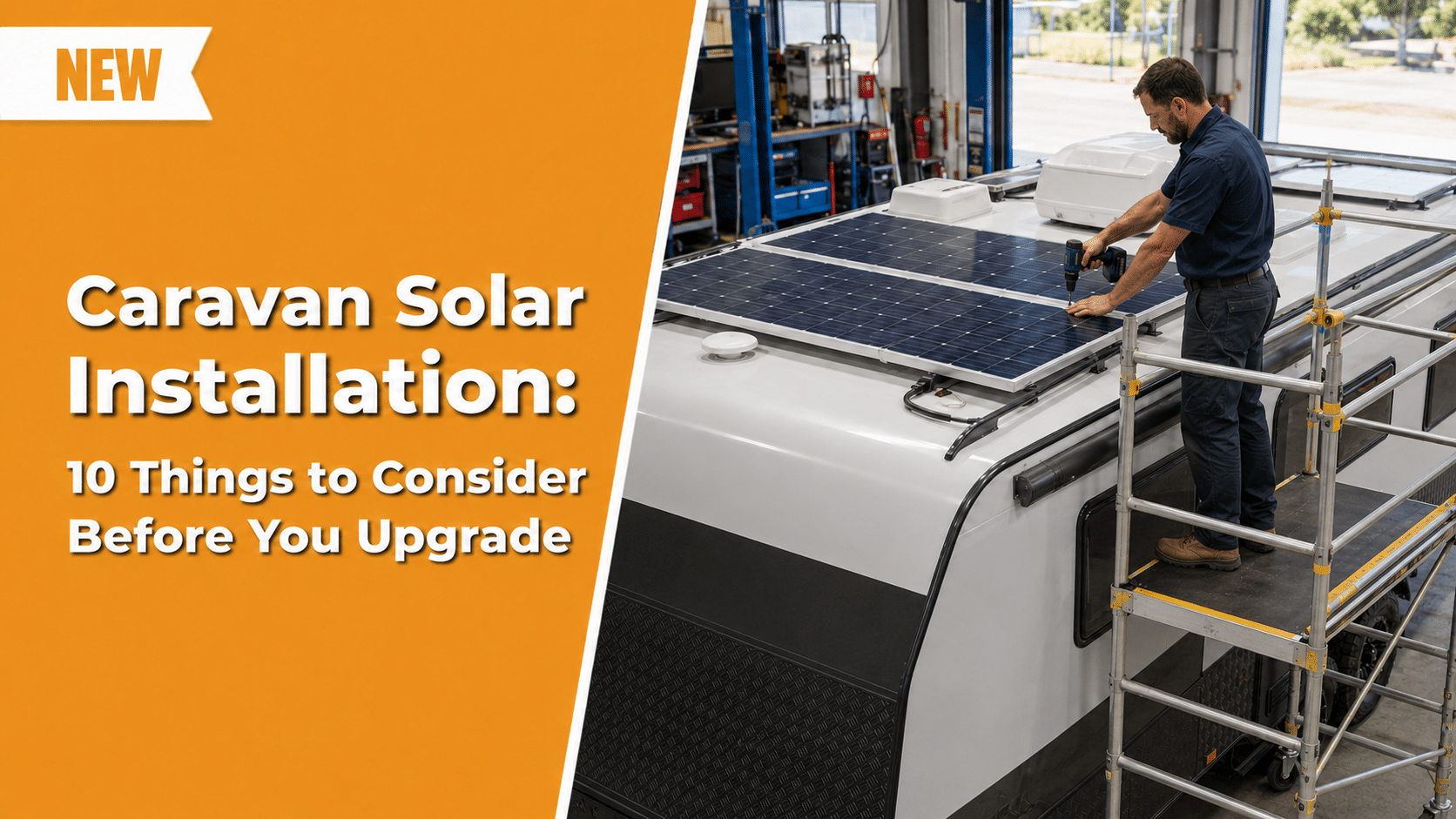
A caravan solar installation must be designed as a complete system. Panels and roof penetrations need secure mounting and weatherproofing, while cables, connectors, isolators, fuses and circuit protection must be correctly selected for the expected current and fault conditions. The installation must also account for roof loading, shading from air conditioners and hatches, ventilation, equipment access and the caravan manufacturer’s requirements.
Lithium batteries need a suitable battery management system, correct charging profiles, physical protection and an installation location that complies with the applicable requirements. Any alteration to the caravan’s 230/240V installation—including inverter-supplied power points and changeover arrangements—must be completed and tested by an appropriately licensed electrical worker. The completed system should comply with the current applicable Australian standards, including AS/NZS 3001.2, as well as equipment and vehicle manufacturer instructions.
How to Choose the Right Caravan Solar Setup
Begin with an honest appliance list and calculate your likely daily watt-hours. Size the battery bank for your required overnight storage and reserve. Then size the solar array to replace that daily energy under the conditions in which you actually travel—not only on a perfect summer day.
Allow for future needs such as Starlink, a larger fridge, an inverter or electric cooking. Planning for expansion can prevent undersized components from needing replacement later.
At AllBrand Caravan Services, we can assess your existing setup, identify charging problems and design solar, lithium battery and off-grid upgrades around your caravan and travel style. If you are unsure how much caravan solar you need, call us on (07) 3869 2969 or contact our Brisbane team.
Frequently Asked Questions
1. Is 200W of Solar Enough for a Caravan?
It can be enough for light power use, especially if you usually stay at powered sites or run refrigeration and cooking on gas. It may not reliably cover a compressor fridge, several devices and extended off-grid camping, particularly in winter or cloudy weather. Calculate your daily watt-hours before deciding.
2. Is 400W of Solar Enough for Off-Grid Caravanning?
For many moderate setups, 400W can make a useful starting point. Whether it is enough depends on your daily consumption, battery capacity, location, season, shade and other charging sources. Travellers using regular inverter loads, Starlink or electric cooking may need more.
3. How Many Solar Panels Do I Need to Charge a 200Ah Lithium Battery?
Battery capacity alone does not determine panel quantity. You need to know how much energy you remove each day and how quickly it must be replaced. A 200Ah battery used lightly needs less solar than the same battery discharged heavily every day. Panel wattage, not simply panel count, is the more useful measure because individual panels have different ratings.
4. Can Caravan Solar Panels Run an Air Conditioner?
Solar panels do not normally power the air conditioner directly; they replenish a battery bank that supplies an appropriately sized inverter. Air conditioning is a large, sustained load, so running it off-grid generally requires substantial solar, battery storage and correctly rated equipment. Runtime will depend on the unit, weather, battery capacity and other loads.
5. Should I Install More Battery Capacity or More Solar?
It depends on the bottleneck. Add storage if you cannot comfortably cover overnight use but can fully recharge the batteries. Add generation if the batteries have enough capacity but fail to recover during the day. In many cases, the best result is a balanced upgrade to both, supported by suitable charging and monitoring equipment.
Need Help Choosing the Right Caravan Solar Setup?
Every caravan and travel setup is different. The AllBrand Caravan Services team can assess your appliances, battery capacity, available roof space and off-grid requirements, then recommend a solar system designed around the way you travel.
Get a Quote Online →