If you’ve towed a caravan through Queensland – especially long stretches between Brisbane, the Sunshine Coast, or out toward the inland highways – you’re relying on one of the smallest components in your entire setup: the wheel bearings.
And they don’t get much attention… until something goes wrong.
From what we see in the workshop at Sandgate, wheel bearing issues are one of the most underestimated failure points in caravanning. They don’t usually fail quietly either – when they go, they go fast.
Heat, distance and load all combine in Queensland conditions to put constant stress on them. That’s why understanding how they work isn’t just technical curiosity – it’s genuine safety.
The Main Problem: Bearings Fail Long Before They Give Warning
Most caravan owners assume wheel bearings give plenty of warning before failure.
In reality, they often don’t.
What typically happens is:
- Gradual wear inside the bearing
- Lubricant breakdown
- Heat buildup
- Sudden failure under load
We’ve seen vans arrive in the workshop after a long trip where everything seemed fine – until a bearing seized on the road.
By that point, damage is often already done to:
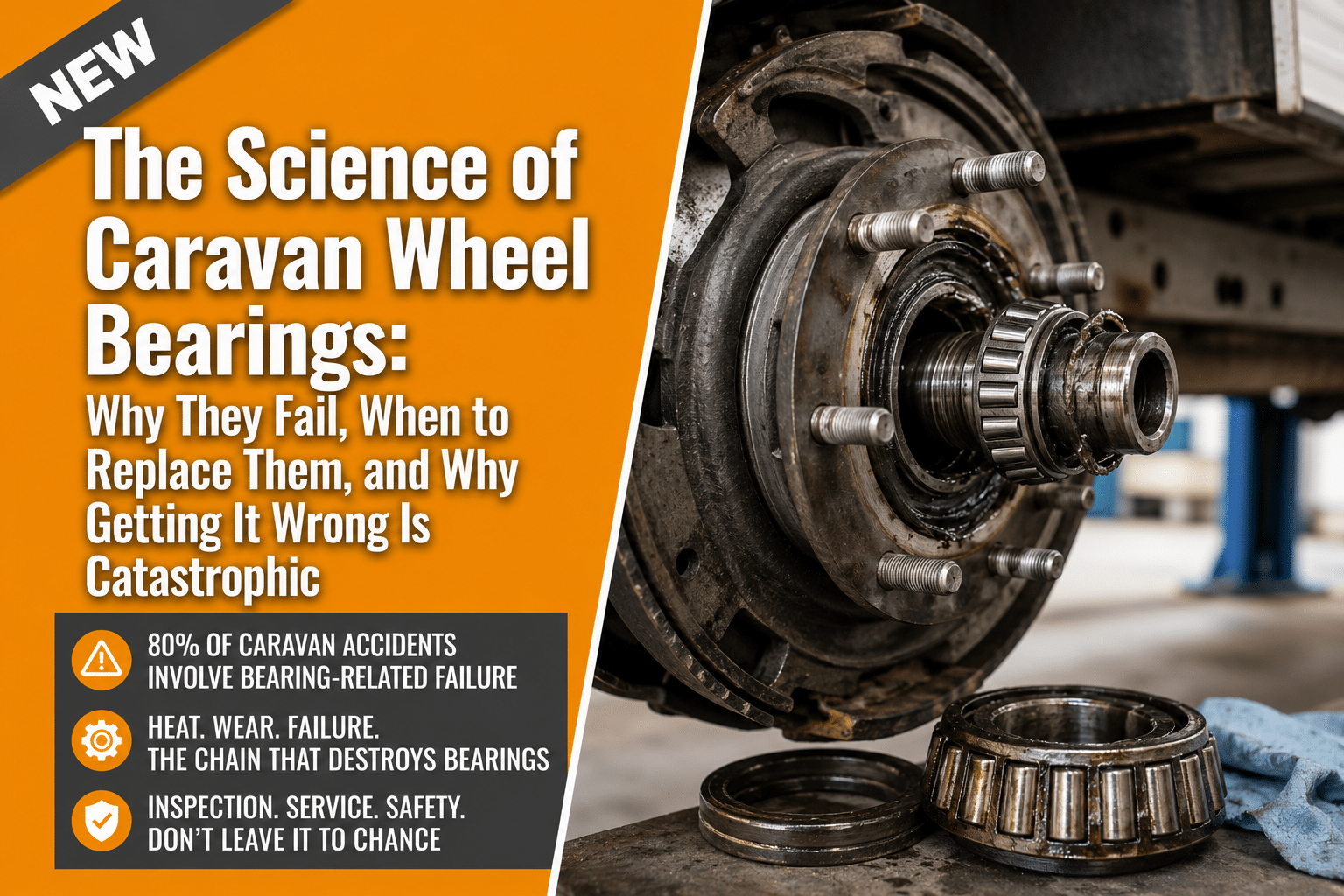
How Caravan Wheel Bearings Actually Work
Most caravans use tapered roller bearings, designed to handle both radial and axial loads.
Inside your wheel hub:
- Inner and outer bearing sets support rotation
- Grease reduces friction
- A bearing race provides the running surface
When everything is healthy, it’s a smooth, low-friction system supporting thousands of kilometres of load.
But it relies heavily on one thing: lubrication staying stable over time.
The Lubricant Breakdown Cycle
Grease inside a bearing doesn’t last forever.
It breaks down due to:
- Heat
- Contamination (dust, water, road grime)
- Mechanical shear
- Age
{Lubricant degradation increases with temperature and time of load cycling}
Once grease loses its properties:
- Friction increases
- Heat builds faster
- Metal surfaces begin to wear directly
This is the start of bearing failure – and it often happens invisibly.
Why Queensland Conditions Accelerate Bearing Wear
Queensland is particularly tough on caravan bearings.
We regularly see accelerated wear due to:
- Long-distance towing at sustained highway speeds
- High ambient temperatures
- Stop-start touring cycles
- Heavy loads (water, batteries, gear)
Heat is the biggest factor.
When bearings heat up:
- Grease thins
- Metal expands
- Tolerances tighten
That combination dramatically increases wear rates compared to cooler climates.
The Seize–Heat–Fire Chain (What Happens When Bearings Fail)
When a bearing starts to fail, it doesn’t usually stop at “a bit of wear”.
It progresses quickly:
1. Initial wear
- Slight roughness begins inside the bearing
- Often no external symptoms
2. Heat buildup
- Friction increases
- Hub temperature rises noticeably
3. Rapid deterioration
- Grease breaks down completely
- Metal-on-metal contact begins
4. Seizure
- Bearing locks
- Wheel may stop rotating properly
5. Secondary damage risk
- Hub damage
- Brake overheating
- In extreme cases, fire risk from sustained heat
We don’t say that lightly – we’ve seen the aftermath.
Bearing Service Intervals vs Real-World Usage
A common misconception is that bearings are “fit and forget” between services.
In reality, service intervals depend heavily on usage:
- Touring frequency
- Load weight
- Distance travelled
- Road conditions
As a general guide in Australia:
- Regular touring caravans: inspect annually
- Heavy-use or long-distance travellers: more frequent checks recommended
But here’s what matters more than time:
Usage intensity beats calendar time every time.
A van doing long QLD highway runs will wear bearings faster than one used occasionally.
Repacking vs Replacement: Where People Get It Wrong
One of the most misunderstood areas is whether bearings should be:
- Repacked with grease
- Or fully replaced
Repacking:
- Involves cleaning and re-greasing
- Suitable only if bearings are in excellent condition
- Requires correct technique and cleanliness
Replacement:
- New bearing sets installed
- Includes races and rollers
- Recommended when wear is present or unknown
We see a lot of DIY repacks done without proper inspection – and that’s where problems start.
Because once a bearing has started to wear internally, fresh grease doesn’t fix structural damage.
Why DIY Bearing Repacking Is High Risk
On paper, repacking bearings looks straightforward.
In reality, it’s one of the most sensitive maintenance tasks on a caravan.
Common DIY issues include:
- Contaminating bearings during reassembly
- Incorrect preload adjustment
- Missed micro-pitting or wear
- Over- or under-greasing
- Incorrect torque on wheel nuts
Even small mistakes can lead to:
- Premature failure
- Heat buildup
- Hub damage on long trips
We’ve had caravans come in where bearings were “just serviced” before a trip – and still failed within hours due to improper setup.
Warning Signs of Bearing Problems
Bearings often give subtle early warnings if you know what to look for:
- Humming or rumbling noise while towing
- Wheel hub unusually warm after travel
- Vibration through the chassis
- Uneven tyre wear
- Slight wobble when checked manually
These signs should never be ignored – they usually indicate advanced wear already in progress.
AllBrand’s Bearing Inspection and Testing Process
In our Sandgate workshop, bearing condition isn’t assumed – it’s tested.
Our process includes:
Temperature inspection after road simulation
Identifying abnormal heat patterns.
Manual play and torque testing
Checking for looseness or resistance issues.
Grease condition analysis
Assessing contamination or breakdown.
Hub and seal inspection
Ensuring no water or dust ingress.
Full replacement when required
Not just repacking if wear is detected.
We treat bearings as a critical safety system – not just a service item.
Repair or Replacement Cost Factors
Costs vary depending on:
- Number of axles
- Bearing condition
- Hub damage (if present)
- Whether seals and brakes are affected
Preventative replacement is always more cost-effective than roadside failure repair – especially when secondary damage occurs.
Preventative Advice from the Workshop
A few simple habits significantly reduce bearing failure risk:
- Get bearings inspected annually
- Avoid DIY repacking unless properly trained
- Check hub temperature during long trips
- Listen for early noise changes
- Service before long-distance touring
- Replace rather than reuse uncertain bearings
In Queensland conditions, prevention is always cheaper than recovery.
Frequently Asked Questions
Q. How often should caravan wheel bearings be replaced in Australia?
It depends on usage, but most touring caravans should be inspected annually and replaced when wear or uncertainty is detected.
Q. What does caravan wheel bearing noise mean?
A humming or rumbling noise often indicates early-stage bearing wear or lack of lubrication.
Q. Can I drive with a noisy wheel bearing?
It’s not recommended. Noise usually indicates developing failure that can escalate quickly.
Q. What happens if a caravan wheel bearing fails?
It can cause heat buildup, wheel seizure, hub damage and in severe cases, loss of control.
Q. How much does caravan wheel bearing replacement cost in Brisbane?
Costs vary depending on axle setup and condition, but replacing bearings early is far cheaper than roadside failure repairs.
Q. Is repacking caravan wheel bearings enough?
Only if bearings are in excellent condition. Otherwise replacement is safer and more reliable.
Q. Why do caravan wheel bearings fail so often in Queensland?
Heat, long-distance towing, heavy loads and road conditions all accelerate wear.
On A Final Note
Wheel bearings are one of the smallest components on your caravan – but they carry some of the biggest consequences when something goes wrong.
From what we see in the workshop, bearing failures rarely happen without reason. They follow a predictable pattern of heat, wear and lubrication breakdown that builds over time.
Understanding that cycle – and servicing them properly – is one of the most important safety steps you can take as a caravan owner in Queensland.
Because when bearings are looked after correctly, they quietly do their job for thousands of kilometres without issue. And that’s exactly how it should be.
📞 Call us: +07 3869 2969
📍 Visit us: 101 Connaught Street, Sandgate Qld 401
📧 Email: [email protected]
Request a Quote Online