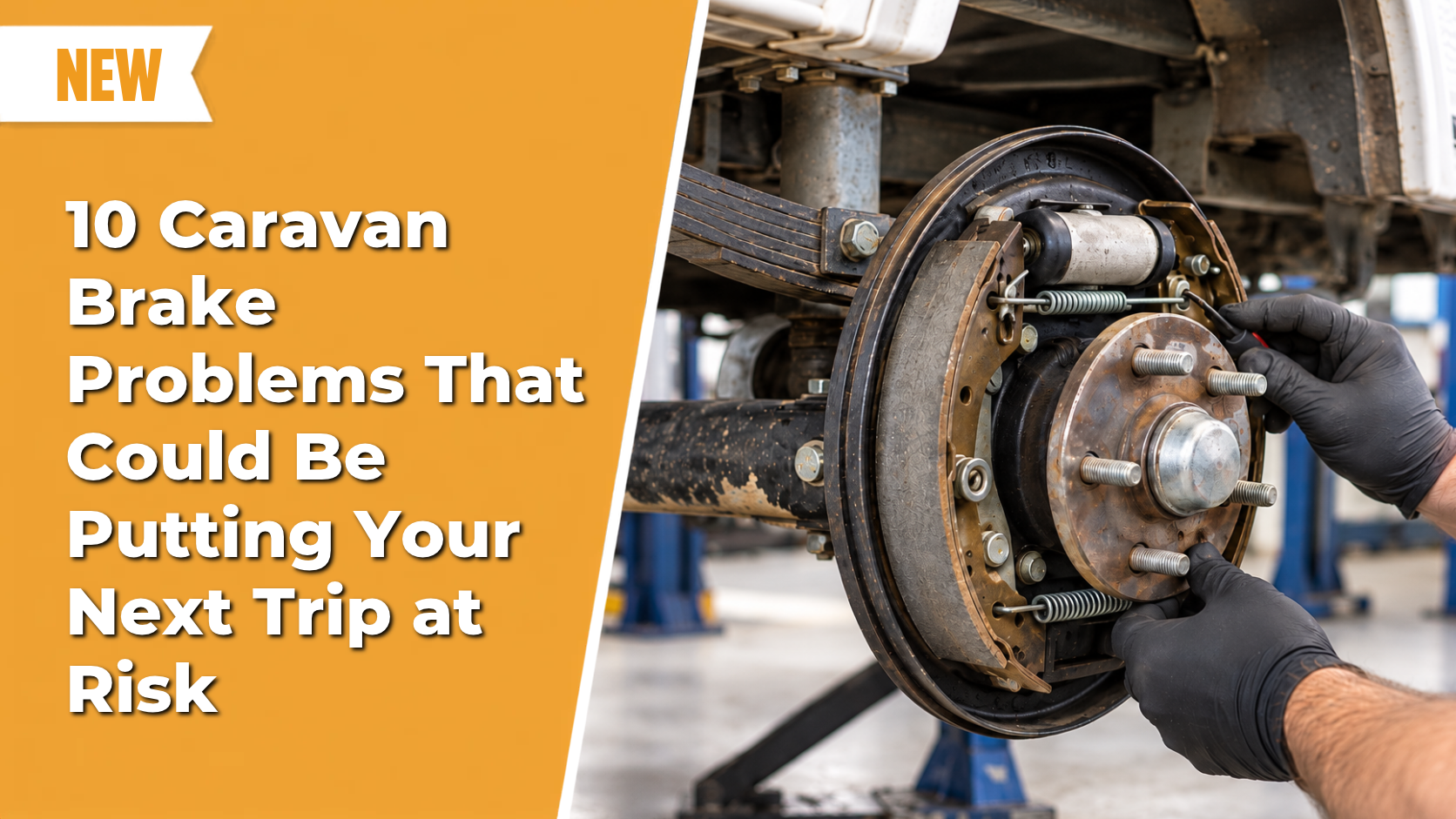
10 Caravan Brake Problems That Could Be Putting Your Next Trip at Risk
Recognise ten common caravan brake problems, from worn shoes and magnets to wiring and controller faults, and learn when to book a brake inspection.


If you’ve spent any time touring around Queensland-whether it’s storing your RV in Brisbane, experiencing coastal humidity up near the Sunshine Coast or long, corrugated inland runs-you’ve probably noticed how much punishment caravans take. From what we’re seeing in the workshop here in Sandgate on Brisbane’s northside, body damage is becoming more common, especially with newer composite vans.
One of the biggest things that catches people out? Not all caravan body repairs are the same. Fibreglass and aluminium behave completely differently, and the repair approach needs to match. Yet we still see plenty of vans coming through after being “repaired” by general panel shops that simply don’t understand caravan construction.
A lot of caravan owners assume a dent is a dent or a crack is a crack. But in reality, the material your van is built from completely changes:
This is where things often go wrong-especially when insurance repairers or non-specialist shops treat caravans like cars.
Let’s break down the two most common caravan body materials and what typically causes damage.
Modern vans often use full composite panels-fibreglass outer skin bonded to a structural core.
Common causes of damage:
Traditional caravans use aluminium sheeting over a frame.
Common causes:
We see this a lot-small cracks or dents getting ignored because they “don’t look too bad”.
Here’s the issue:
In Queensland conditions-heat, humidity and road vibration-these issues accelerate quickly.
Proper caravan body repair starts with understanding what’s happening beneath the surface.
In our workshop, that usually involves:
This step is where non-specialists often fall short. A repair might look fine on the outside but fail within months.
Fibreglass repairs are more like boat building than car panel work.
Typical process:
Key challenges:
Cost factors:
This is why fibreglass caravan repair in Brisbane can vary significantly in cost.
Aluminium behaves very differently-it doesn’t “blend” like fibreglass.
Typical repair options:
Here’s the reality:
In many cases, replacing the panel is the only proper repair.
Key challenges:
Cost factors:
Aluminium caravan repair in Brisbane is often more straightforward structurally-but visually, it can be harder to hide.
A lot of this damage is avoidable with a bit of awareness.
We usually recommend:
A common pattern we see-people wait too long, and what could’ve been a simple repair turns into a major rebuild.
It depends on the damage. Fibreglass can be reshaped and rebuilt, which allows seamless repairs-but it requires specialist skills. Aluminium is simpler structurally but often needs full panel replacement to look right.
Because it’s labour-intensive and requires layering, curing, sanding and colour matching. It’s not a quick fix-it’s a skilled process.
Not always properly. Traditional panel beaters are trained for metal, not composite materials. This is where a lot of poor repairs come from.
Signs include soft walls, internal movement, recurring cracks or water ingress. A proper inspection is the only way to be sure.
Most policies do-but the quality of repair depends heavily on the repairer. Not all insurance-approved shops specialise in caravans.
Sometimes-but results are limited. Creased or stretched aluminium usually requires replacement for a proper finish.
Absolutely. Heat impacts expansion, curing times (for fibreglass), and long-term durability. Repairs need to account for local conditions.
From what we see every day in the workshop, the biggest mistake caravan owners make is assuming all body repairs are the same.
They’re not.
Fibreglass and aluminium require completely different approaches, tools and experience. Getting it wrong doesn’t just affect how your van looks-it affects how it performs, how long it lasts, and whether problems come back.
If there’s one thing we’d suggest, it’s this: get the right diagnosis early, and make sure whoever is repairing your van understands caravan construction-not just automotive panels.
That’s the difference between a repair that lasts… and one that doesn’t.
📞 Call us: 07 38692969
📍 Visit us: 101 Connaught Street, Sandgate Qld 4017
📧 Email: [email protected]