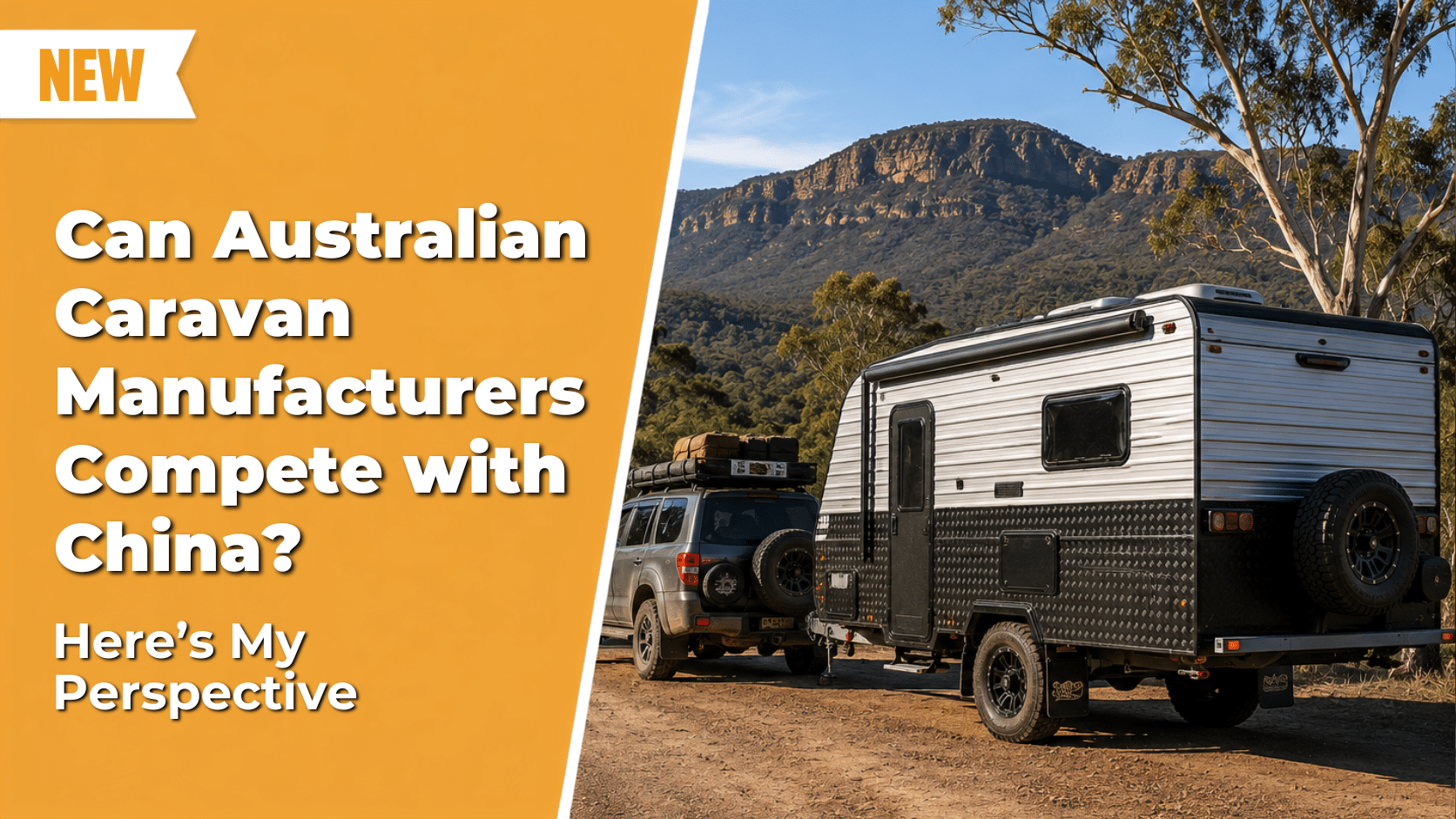
It’s probably one of the questions I’ve been asked more than any other over the past couple of years.
“What do you think about the Chinese caravans?”
Sometimes it’s followed by another question.
“Are they killing Australian manufacturing?”
As someone who’s spent more than 30 years in the caravan industry, runs a caravan repair business, and serves as a Board Member of Caravanning Queensland, I’ve had the opportunity to see thousands of caravans come through our workshop.
We’ve repaired Australian-built caravans as well as imported caravans.
We’ve seen some beautifully built vans. We’ve also seen some that leave us scratching our heads.
So I thought I’d share my perspective.
It’s not as simple as “Australian good, Chinese bad”
Let’s get one thing out of the way.
The conversation is often far too black and white.
Some people will tell you Australian-built caravans are the only ones worth buying.
Others will tell you imported caravans offer far better value for money.
The truth, as it usually is, sits somewhere in the middle.
I’ve seen Australian caravans that have been built exceptionally well.
I’ve also seen Australian caravans with problems.
Likewise, I’ve seen imported caravans that have impressed me, and others that haven’t.
The country where a caravan is built doesn’t automatically determine whether it’s a good caravan.
What matters is how it’s engineered, how it’s assembled, the quality of the components used and, just as importantly, what happens after you take delivery.
And is it a personal decision to back an Australian-made product or not.
Why are imported caravans often cheaper?
This is where it’s important to understand how manufacturing works.
Australian manufacturers operate in one of the most highly regulated business environments in the world.
They’re paying Australian wages, superannuation, workers’ comp, higher power costs, and complying with Australian workplace laws.
And they’re dealing with rising insurance premiums, freight costs and the increasing cost of raw materials.
Many overseas manufacturers operate at a much larger scale, with different labour costs, different supply chains, and different production models.
That often allows them to produce caravans at a lower cost, which doesn’t mean lower quality sometimes.
It’s one of the reasons imported caravans can sometimes offer an impressive list of features for a very competitive price.
Australian manufacturers have strengths too
Where I believe Australian manufacturers continue to stand out is their understanding of Australian conditions.
Anyone who’s travelled this country knows our roads can be unforgiving.
- Corrugations.
- Heat.
- Dust.
- Heavy rain.
- Long distances between towns.
Those conditions place enormous stress on a caravan.
Australian manufacturers have spent decades designing products specifically for those environments. That experience is incredibly valuable.
Many also offer greater flexibility when it comes to customisation, allowing buyers to tailor layouts and features to suit the way they travel.
The part buyers often overlook
One thing I don’t think gets talked about enough is what happens after you buy the caravan.
Buying is only the beginning. Eventually, every caravan needs servicing.
When that happens, good after-sales support becomes incredibly important.
- Can you get parts?
- Is there someone to answer your questions?
- Is there an established dealer or repair network?
- Will the business still be around in five or ten years?
Those questions are just as important as the floor plan or the size of the fridge.
Competition isn’t the enemy
Some people see imported caravans as a threat, which they can be, as per removing sales from Australian manufacturers, and then this brings about changes in employment within the country, and the outlays of products can be seen to be removed from the Australian Economy
I prefer to look at it with open eyes and thoughts, which sometimes is not always correct in everyone’s eyes.
Competition makes every industry better.
It encourages innovation and pushes manufacturers to improve quality.
It also drives businesses to deliver better customer service.
Ultimately, that’s good for caravan owners.
The challenge for Australian manufacturers isn’t simply to compete on price. That’s always going to be difficult. The opportunity is to compete on quality, service, innovation and long-term customer support.
What we see in the workshop
One of the advantages of being in the repair industry is that we get to see caravans years after they’ve left the showroom.
That’s when you really start to understand how products perform over time.
Rather than judging a caravan on how it looks on delivery day, we see how it copes after thousands of kilometres on Australian roads.
And if there’s one thing I’ve learnt, it’s this:
No manufacturer is perfect.
Every brand has strengths and every brand has areas where it can improve.
That’s why I encourage people to avoid making decisions based purely on country of origin.
The recent manufacturer closures have changed the conversation
The recent closures of several Australian manufacturers have understandably made buyers more cautious.
Just be mindful that there have been many, many imported branded caravans that have sold caravans to the Australian consumers and then not been there to help them as they have closed down as well, but as per it is not pursued in the media as we are seeing at this moment in time
People aren’t just asking whether a caravan is good.
They’re asking whether the company behind it will still be around in ten years’ time.
That’s a fair question.
Whether you’re buying Australian-built or imported, it’s worth looking beyond the caravan itself.
- Research the company.
- Understand their support network.
- Read reviews.
- Talk to existing owners.
- Ask about parts availability.
- Find out who will service the caravan in your area.
Buying a caravan is one of the biggest recreational purchases many families will ever make.
Taking the time to do your homework is always worthwhile.
So, can Australian manufacturers compete?
Absolutely.
But I don’t think the future will be won by trying to build the cheapest caravan.
I think it’ll be won by building the best customer experience.
The manufacturers that succeed will be those who continue investing in quality, innovation, customer support, and long-term relationships, and being the finishing touches for the consumer, from the manufacturing, to the dealership, to the warranty repairs, is seamless and not a worry for the consumer, and the process will help the end consumer feel well looked after which at the moment I hear all the time this is a fault in the industry.
Australians have always appreciated businesses that stand behind what they build.
That hasn’t changed.
My advice to anyone buying a caravan
If I could give one piece of advice, it would be this.
Don’t buy a caravan based on the sticker price alone.
Look at the whole picture.
- Who built it?
- How long have they been around?
- What’s their reputation?
- Who can service it?
- Are parts readily available?
- Do they have a strong dealer network?
- How do they handle warranty claims?
These are the questions that often matter far more than whether the caravan was built in Brisbane, Melbourne, or overseas.
At the end of the day, the best caravan is the one that suits the way you travel, fits your budget, and is backed by people you can trust.
Final thoughts
I don’t think this is a story about Australia versus China.
It’s a story about an industry that’s evolving.
Australian manufacturers are operating in an increasingly competitive global market, and that’s challenging as per we are seeing this across the globe.
But it’s also creating opportunities to innovate, improve and focus on what they do best.
As someone who’s passionate about this industry, I’d love to see Australian manufacturing continue to thrive.
We have incredibly talented people building outstanding products in this country.
At the same time, I hope buyers continue to ask questions, do their research and make informed decisions.
An informed customer is good for everyone.
Frequently Asked Questions
Q. Are Chinese-built caravans improving?
Yes. Many imported caravans have improved significantly in recent years. As with Australian-built caravans, build quality can vary between manufacturers, so it’s important to assess each brand on its own merits.
Q. Why are Australian-built caravans usually more expensive?
Australian manufacturers face higher labour costs, stricter workplace regulations, higher insurance premiums, energy costs and material costs. These factors all contribute to the final purchase price.
Q. Should I only buy an Australian-built caravan?
Not necessarily. Focus on the quality of the build, the manufacturer’s reputation, after-sales support, warranty and the availability of servicing and spare parts, rather than country of manufacture alone.
Q. Is after-sales support really that important?
Absolutely. A caravan is a long-term investment. Good after-sales support can make a significant difference throughout the life of your caravan.
Q. What should I look for before buying any caravan?
Research the manufacturer, read owner reviews, inspect build quality, understand the warranty, ask about servicing and parts availability, and buy from a business with a proven reputation for supporting its customers.
References
📞 Call us: 07 3869 2969
📍 Visit us: 101 Connaught Street, Sandgate Qld 4017
📧 Email: [email protected]