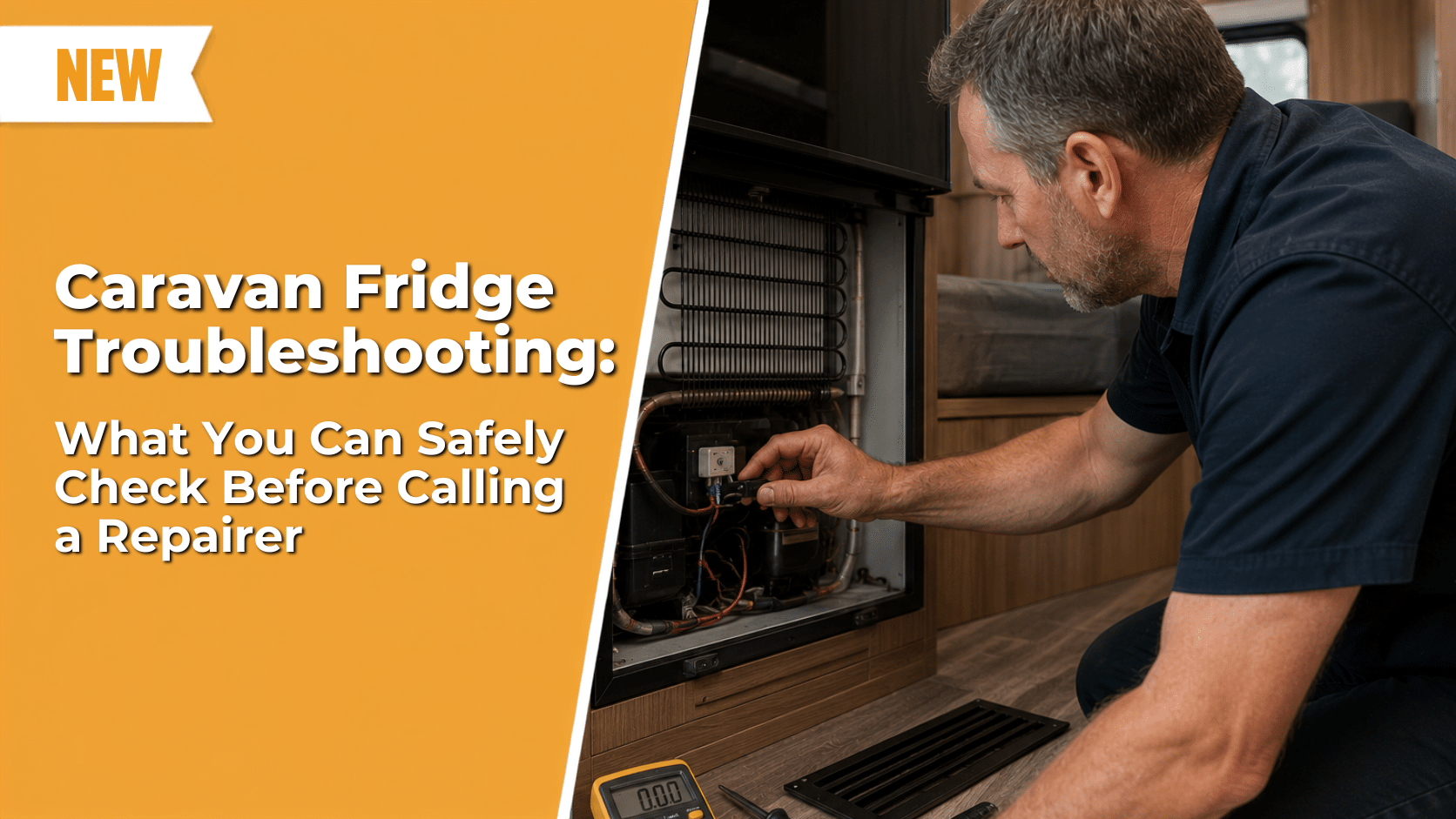
There are few things more frustrating than opening your caravan fridge and discovering warm food, melting ice or a refrigerator that has stopped working altogether.
Before assuming the fridge needs replacing, there are several safe caravan fridge troubleshooting checks you can perform yourself. Some caravan fridge problems are caused by simple issues such as poor ventilation, low battery voltage, incorrect power settings, overpacking or a door that is not sealing properly.
Other faults may involve the LPG system, 240-volt wiring, heating elements, control boards or the fridge cooling unit. These problems should be inspected by a qualified caravan fridge repair technician.
This guide explains what you can safely check, how to identify common caravan fridge problems and when it is time to stop troubleshooting and call a professional.
First, Identify Your Type of Caravan Fridge
Before you begin troubleshooting, it is important to know what type of fridge is installed in your caravan.
The two most common types are three-way absorption fridges and compressor fridges.
Three-Way Absorption Fridges
A three-way caravan fridge can usually operate on:
- LPG gas
- 240-volt mains power
- 12-volt power while travelling
Three-way caravan fridges use heat and a chemical absorption process to create cooling. They do not operate in the same way as a standard household compressor fridge.
Compressor Caravan Fridges
A compressor caravan fridge works more like the refrigerator in your home. It usually runs on 12-volt or 24-volt battery power and may also operate using a 240-volt adaptor or power supply.
Compressor fridges are generally less affected by the angle of the caravan, but they can be sensitive to low battery voltage, voltage drop, undersized wiring and poor electrical connections.
Knowing which type you have will make it easier to identify the likely cause of the problem.
1. Check Whether the Caravan Fridge Has Power
Start with the most obvious question: is the fridge receiving power?
Check the control panel, display, warning lights and internal light. Make sure the fridge is switched on and that the correct operating mode has been selected.
If you are trying to run the fridge on 240-volt power, safely check that:
- The caravan is connected to mains power.
- The external lead is connected correctly.
- The caravan circuit breaker has not tripped.
- Other 240-volt appliances are working.
- The fridge has been selected to operate on 240 volts.
If other appliances are working but the fridge is not, the fault may involve the fridge heating element, thermostat, wiring or control system.
Do not remove electrical covers or attempt to repair 240-volt wiring yourself.
If the fridge repeatedly trips a circuit breaker, stop using it and arrange a professional caravan fridge inspection.
2. Check the 12-Volt Battery Supply
For a compressor fridge, a low battery or voltage drop is one of the most common reasons the fridge stops working, cycles repeatedly or displays a low-voltage error.
Check whether other 12-volt appliances are operating normally. Also check the battery monitor if your caravan has one.
A battery can appear to have an acceptable voltage when no appliances are running, but the voltage may drop sharply when the fridge compressor attempts to start.
Possible causes include:
- A discharged or failing battery
- Loose battery terminals
- Corroded electrical connections
- Undersized wiring
- Excessive cable length
- A damaged fuse or fuse holder
- Voltage drop under load
If the fridge starts and stops, runs intermittently or displays a low-voltage fault, the problem may be with the battery supply or wiring rather than the refrigerator itself.
A technician can test the voltage at the fridge while the compressor is attempting to operate.
3. Confirm the Correct Power Source Is Selected
Many three-way caravan fridge problems occur because the refrigerator is not set to the correct energy source.
Some caravan fridges require the user to manually select gas, 240 volts or 12 volts. Others use an automatic energy selection system.
Check the control panel and confirm that the selected setting matches the power source available.
As a general guide:
- Use 240-volt mode when connected to mains power.
- Use gas mode when safely parked and operating from LPG.
- Use 12-volt mode while travelling, where the caravan is wired for it.
On many three-way absorption fridges, the 12-volt setting is designed mainly to maintain the temperature of an already cold fridge while the tow vehicle is running.
It is usually not the best setting for cooling a warm fridge from room temperature. On many installations, the 12-volt mode will not operate unless the vehicle engine is running.
If the caravan fridge works on one energy source but not another, the fault is likely within that particular operating system.
Common examples include:
- The caravan fridge works on gas but not 240 volts.
- The fridge works on 240 volts but not gas.
- The fridge works when plugged in but not while driving.
- The fridge works on electricity but does not ignite on LPG.
These faults generally require professional diagnosis.
4. Make Sure the Caravan Is Reasonably Level
Absorption caravan fridges rely partly on gravity to circulate the cooling solution through the system.
Older three-way fridges may be particularly sensitive to operating on a steep angle. Many newer caravan fridges can tolerate a modest incline, but they should still be operated within the manufacturer’s specifications.
If your caravan is noticeably off-level, correct the position and see whether the fridge performance improves.
Use a spirit level or the caravan’s levelling system to check the position from side to side and front to back.
A caravan does not necessarily need to be perfectly level, but operating an absorption fridge for an extended period on a significant slope can reduce cooling performance and may contribute to cooling-system problems.
Compressor caravan fridges are generally less sensitive to levelling, although they should still be used according to the manufacturer’s instructions.
5. Give the Fridge Enough Time to Cool Down
Caravan fridges often cool more slowly than household refrigerators, particularly three-way absorption models.
If you have only recently turned the fridge on, it may need several hours to reach a safe temperature. In hot weather, it can take considerably longer.
For the best results:
- Turn the fridge on the day before your trip.
- Allow it to cool overnight.
- Load it with food and drinks that are already chilled.
- Avoid placing large amounts of warm food inside.
- Minimise how often the fridge door is opened.
A common mistake is turning on a warm caravan fridge shortly before leaving and expecting it to become cold within an hour.
The 12-volt travel setting may help maintain the existing temperature while driving, but it may struggle to cool down a fridge that was warm when the journey began.
6. Check the Actual Fridge Temperature
A caravan fridge can feel cool without being cold enough to store food safely.
Place a refrigerator thermometer inside the main compartment and monitor it over several hours.
The fresh-food compartment should generally remain at 5°C or below. The freezer should remain frozen and, where the appliance is designed to achieve it, ideally operate around -18°C.
Do not rely only on touching the fridge walls or shelves. The air can feel cool even when the food storage temperature is too high.
If the freezer is cold but the main fridge compartment remains warm, possible causes may include:
- Incorrect loading
- Poor heat transfer
- Insufficient ventilation
- A faulty temperature sensor
- A thermistor problem
- A thermostat fault
- A developing cooling-unit problem
If the fridge is freezing food, failing to regulate temperature or running continuously, the temperature sensor, thermostat or control board may need testing.
7. Inspect the Caravan Fridge Door Seal
A damaged or poorly sealing fridge door allows warm air to enter the refrigerator, making it difficult to maintain temperature.
Inspect the rubber seal for:
- Cracks
- Splits
- Warping
- Loose areas
- Dirt or food residue
- Sections that no longer make proper contact
You can perform a simple paper test by closing the fridge door over a sheet of paper. Gently pull the paper.
If it slides out very easily, particularly in one section of the door, the seal may not be making firm contact.
Clean the seal using mild soapy water and dry it thoroughly. Avoid strong chemicals that may damage or harden the rubber.
Also check that containers, shelves or food packaging are not preventing the door from closing fully.
A damaged caravan fridge seal may need to be adjusted or replaced.
8. Avoid Overpacking the Fridge
A tightly packed caravan fridge may not cool evenly because cold air and heat transfer cannot occur effectively.
Avoid pushing food and containers hard against the rear wall. Leave some space between items so air can move through the fridge.
Look for:
- Large containers blocking airflow
- Food pressed against cooling fins
- Items covering internal vents
- Shelves packed tightly from front to back
- Bottles or containers preventing the door from closing
A completely empty fridge can also warm quickly whenever the door is opened. A moderately filled fridge containing pre-chilled items generally maintains temperature more effectively.
9. Inspect the External Caravan Fridge Vents
Three-way absorption fridges rely on correct ventilation to release heat from the rear of the appliance.
Most caravans have a lower external vent that allows cooler air to enter and an upper vent or roof vent that allows hot air to escape.
Visually inspect the external vent grilles for obvious obstructions such as:
- Leaves
- Dirt
- Dust
- Spider webs
- Insect nests
- Stored items blocking the vents
- Accessories restricting airflow
You may clean the outer vent grille if it is safely accessible.
Do not reach into the rear fridge compartment, remove burner covers or disturb gas components unless you are appropriately qualified.
Poor ventilation is a common cause of a caravan fridge not cooling properly, especially during a Queensland summer.
10. Consider the Outside Temperature
Caravan fridges can struggle in very hot conditions, particularly if the fridge side of the caravan is exposed to direct afternoon sun.
An absorption fridge removes heat from inside the refrigerator and releases it through the outside vents. When the outside air is already extremely hot, this heat exchange becomes less effective.
You may improve caravan fridge performance by:
- Parking with the fridge side in the shade
- Using an awning where appropriate
- Keeping the external vents clear
- Pre-cooling food and drinks
- Opening the fridge door less frequently
- Avoiding hot food inside the fridge
- Keeping the caravan reasonably level
Never block the vents in an attempt to keep heat out. The fridge requires airflow to operate safely and efficiently.
Some caravan fridge installations use ventilation fans to improve cooling performance. If the fan is not operating, it may require professional inspection.
11. Check Whether the Problem Started After an Upgrade or Renovation
If the fridge problem began after a caravan renovation, solar installation, battery upgrade, cabinet modification or fridge replacement, the fault may be related to the installation rather than the appliance.
Possible installation problems include:
- Incorrect external ventilation
- Missing air baffles
- Excessive gaps around the fridge
- Inadequate cable size
- Poor electrical connections
- Incorrect polarity
- Insufficient clearance
- The fridge not being sealed correctly from the caravan interior
A caravan fridge depends on correct wiring, ventilation, clearances and installation to operate properly.
If the problem began after recent work, arrange for the installation to be checked.
12. Watch for Serious Warning Signs
Some caravan fridge warning signs mean you should stop troubleshooting and arrange a professional inspection.
These include:
- A smell similar to ammonia
- Yellow residue near the cooling system
- A smell of LPG
- Soot around the exterior fridge vent
- Scorching or heat damage
- Repeated failed gas ignition
- A gas flame that will not stay alight
- Repeated clicking
- Circuit breakers tripping
- Fuses repeatedly blowing
- Melted wiring
- An electrical burning smell
- Error codes that return after a reset
An ammonia smell or yellow residue may indicate a leak from the sealed absorption cooling unit.
If you notice either sign, switch the fridge off, ventilate the area and arrange a professional inspection.
If you smell LPG, turn off the gas supply if it is safe to do so, avoid flames and electrical switches and move away from the immediate area.
Caravan Fridge Gas Problems
If the caravan fridge will not ignite on gas, repeatedly clicks or the flame will not stay alight, the problem may involve:
- A dirty burner
- A blocked gas jet
- A faulty igniter
- A faulty flame-sensing electrode
- Incorrect gas pressure
- Poor flue operation
- Insect contamination
- A control-board fault
- Inadequate ventilation
These components should be inspected and serviced by a suitably qualified gas technician.
Do not dismantle the burner, clean the gas jet with tools or attempt to adjust the gas pressure yourself.
Should You Reset Your Caravan Fridge?
Some caravan fridges can be reset after a temporary operating fault.
The correct reset method varies between models, so refer to the owner’s manual for your specific fridge.
A reset may clear an error caused by:
- A brief power interruption
- A failed gas ignition attempt
- Low battery voltage
- Switching between power sources
- A temporary control-panel error
However, repeatedly resetting the fridge without identifying the underlying fault is not a repair.
If the error code returns, record the code and provide it to the caravan fridge technician.
What You Should Not Attempt Yourself
There is an important difference between safe caravan fridge troubleshooting and repairing gas or electrical systems.
Do not attempt to:
- Repair or alter LPG lines
- Adjust gas pressure
- Dismantle the burner
- Modify the gas jet
- Bypass safety switches
- Repair 240-volt wiring
- Replace electrical components without suitable qualifications
- Drill into the fridge walls
- Modify the cooling system
- Block or alter ventilation
- Continue using a fridge that smells of gas or ammonia
Unsafe DIY caravan fridge repairs can create a risk of gas leaks, fire, electric shock or carbon monoxide exposure.
They may also cause additional damage and make the final repair more expensive.
When to Book a Caravan Fridge Repair
Arrange a professional caravan fridge inspection when:
- The fridge is not cooling after the basic checks.
- It works on one power source but not another.
- The gas burner will not ignite or stay alight.
- It repeatedly displays an error code.
- The compressor fridge cuts in and out.
- The fridge is tripping the caravan’s electrical system.
- The cooling performance is becoming worse.
- You notice soot, yellow residue or unusual smells.
- The refrigerator has not been serviced for a long time.
- You are uncertain whether the fridge is safe to use.
Some problems involving door seals, heating elements, controls, wiring, ventilation and gas burners may be repairable.
However, a leaking sealed cooling unit, extensive cabinet damage or unavailable replacement parts may make replacing the fridge the more economical option.
A professional diagnosis can help you decide whether caravan fridge repair or replacement offers the best value.
Caravan Fridge Repairs in Brisbane
Allbrand Caravan Services provides caravan fridge diagnosis, servicing and repairs from its Sandgate workshop.
The team assists caravan owners from Brisbane, the Sunshine Coast, Gold Coast and Ipswich with caravan fridge faults, servicing and broader caravan repair needs.
Whether your caravan fridge is not cooling, has stopped operating on gas or electricity, is displaying an error code or needs to be checked before your next trip, early diagnosis can help prevent spoiled food, disrupted holidays and more expensive repairs.
Contact Allbrand Caravan Services to arrange a professional caravan fridge inspection or repair.
Frequently Asked Questions
Q. Why is my caravan fridge running but not getting cold?
A caravan fridge may run without cooling properly because of poor ventilation, hot weather, low voltage, an incorrect power setting, a damaged door seal, overpacking or an internal cooling fault. Check the operating mode, caravan level, external vents and fridge temperature. If it remains warm after several hours, arrange a professional inspection.
Q. How long does a caravan fridge take to get cold?
A three-way absorption caravan fridge may take several hours to reach a safe temperature and can take longer during hot weather. For the best results, switch it on the day before travelling and load it with food and drinks that are already chilled.
Q. Why does my caravan fridge work on gas but not on 240 volts?
If the fridge works on gas but not on 240-volt electricity, the problem may involve the mains supply, heating element, thermostat, fuse, wiring or control board. You can safely confirm that the caravan has power, but internal electrical testing should be completed by a qualified repairer.
Q. Why does my compressor caravan fridge keep cutting out?
A compressor fridge may repeatedly cut out because of low battery voltage, voltage drop, loose terminals, corroded connections, undersized wiring or a failing battery. The voltage should be tested at the fridge while the compressor is attempting to start.
Q. Is it worth repairing an old caravan fridge?
It depends on the fridge’s age, condition, fault, parts availability and replacement cost. Door seals, heating elements, burners, wiring and controls can often be repaired. A failed sealed cooling unit or extensive deterioration may make replacement the more practical option. A professional diagnosis will help determine the best solution.
Still Having Trouble With Your Caravan Fridge?
Basic checks can sometimes resolve simple caravan fridge problems, but persistent cooling issues, unusual noises, electrical faults or gas-related concerns require professional diagnosis.
At AllBrand Caravan Services, our experienced technicians can inspect your caravan fridge, determine why it isn’t operating correctly and recommend the safest and most practical repair. Whether the issue involves the power supply, gas system, ventilation or the fridge itself, we’ll help you get it sorted before your next trip.
Don’t risk spoiled food or an unsafe appliance while travelling. Request a quote from our team today.
📞 Call us: 07 3869 2969
📍 Visit us: 101 Connaught Street, Sandgate Qld 4017
📧 Email: [email protected]