If you’re travelling around Southeast Queensland – especially near Brisbane, Sandgate and the coastal strip – your caravan is constantly exposed to something most owners don’t think about: corrosive conditions underneath the van.
Salt air, humidity, wet roads and even floodwater all play a role.
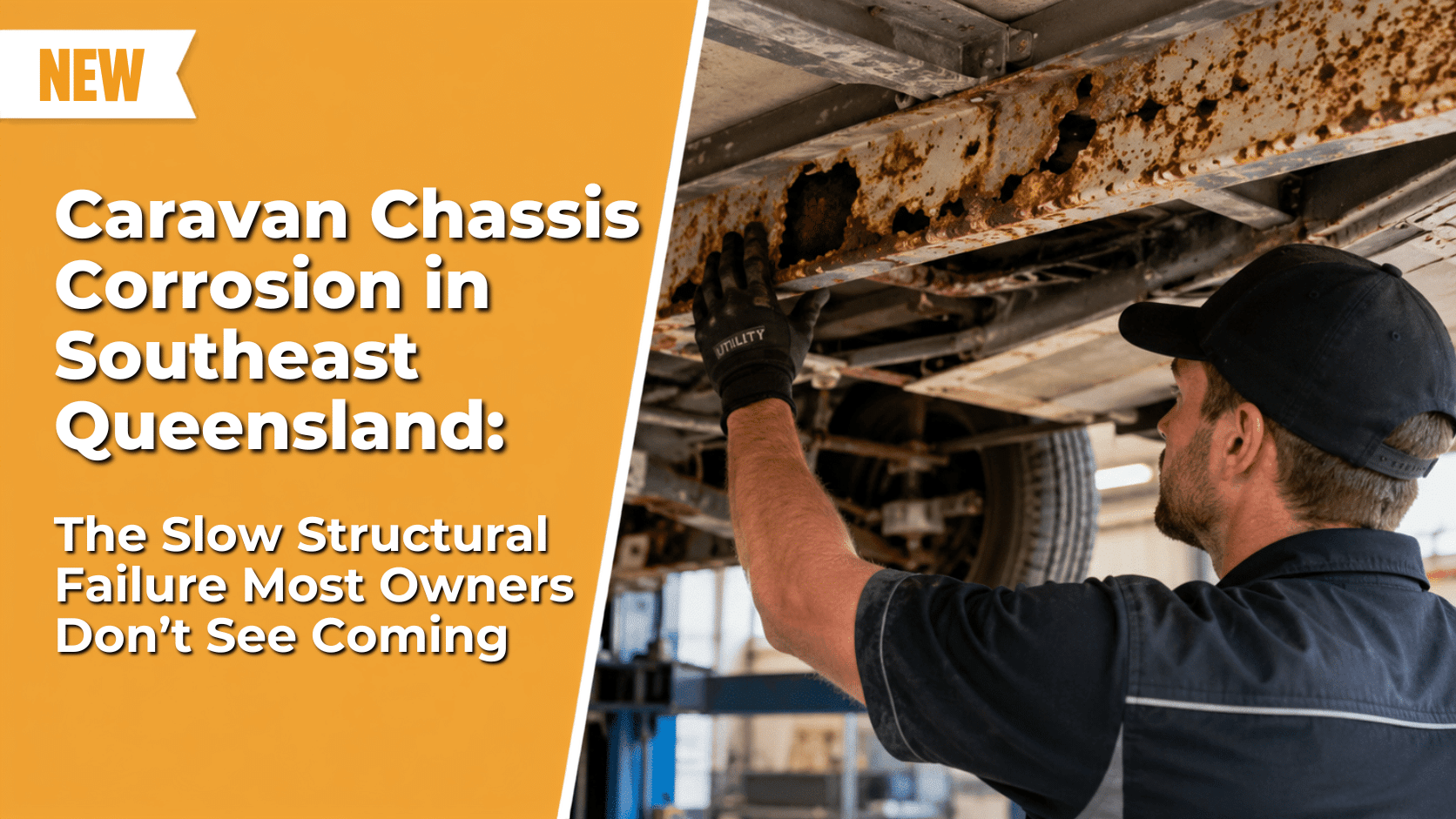
From what we see in the workshop, chassis corrosion is one of the most overlooked issues in caravanning – and one of the most serious when it’s left too long.
The tricky part? It develops slowly, out of sight, and often goes unnoticed until structural strength is already compromised.
The Main Problem: Corrosion You Can’t Easily See
Unlike a cracked panel or electrical fault, chassis corrosion doesn’t announce itself early.
It starts underneath:
- On the chassis rails
- Around crossmembers
- At weld points
- Behind protective coatings
And because it’s out of sight, it’s rarely checked properly.
We see this a lot – vans that look great above the floor, but underneath are already showing signs of structural deterioration.
Caravan Chassis Construction: What You’re Actually Towing
Most caravan chassis are built from:
- Mild steel box section
- RHS (rectangular hollow section)
- Welded crossmembers for support
These components are strong – but only while the steel remains intact and protected.
Once corrosion begins:
- Steel thickness reduces
- Structural strength drops
- Load distribution changes
And that’s where problems start to escalate.
Why Southeast Queensland Is So Tough on Chassis
This region has a combination of factors that accelerate corrosion more than many other parts of Australia.
Coastal salt air
Salt particles settle underneath the van and attract moisture.
High humidity
Moisture lingers longer, especially under enclosed areas.
Wet roads and spray
Driving in rain pushes water and contaminants into chassis cavities.
Floodwater and mud exposure
Even a single floodwater crossing can introduce:
- Silt
- Organic material
- Contaminants that trap moisture
From what we’re seeing, even vans that aren’t used off-road can develop corrosion simply from coastal touring and storage conditions.
What Structural Corrosion Actually Looks Like
Not all rust is equal.
Surface rust is common and often manageable.
Structural corrosion is different – and more serious.
Signs include:
- Flaking or scaling metal
- Pitting in steel surfaces
- Rust forming around welds
- Swelling or distortion of metal sections
- Weakening at mounting points
This is where structural integrity starts to become a concern.
Crossmember Failure: The Hidden Risk
Crossmembers are critical parts of your chassis.
They:
- Support the floor structure
- Distribute load across the chassis
- Anchor key components
When corrosion affects crossmembers:
- Load paths are compromised
- Flex increases
- Structural fatigue accelerates
We’ve seen cases where crossmembers have significantly weakened without any obvious signs from above.
How Corrosion Progresses Over Time
Chassis corrosion typically follows a pattern:
Stage 1: Surface oxidation
- Minor rust forming on exposed steel
Stage 2: Coating breakdown
- Protective layers begin to fail
Stage 3: Moisture retention
- Dirt and debris trap moisture against steel
Stage 4: Pitting and material loss
Stage 5: Structural compromise
- Load-bearing strength is reduced
By the time it reaches later stages, repair becomes more complex.
DIY Inspection vs Professional Inspection
There are a few things owners can check themselves:
DIY checks:
- Visual inspection with a torch
- Looking for rust flakes or scaling
- Checking around suspension mounts
- Inspecting exposed chassis rails
But here’s the limitation:
You can’t always see:
- Internal corrosion inside box sections
- Hidden rust behind components
- Structural weakening without proper tools
That’s where professional inspection becomes important.
How We Inspect Chassis at the Workshop
At our Sandgate workshop, a proper chassis inspection includes:
- Full underbody visual inspection
- Checking high-risk corrosion zones
- Assessing weld integrity
- Identifying moisture traps and debris buildup
- Evaluating structural strength where needed
We’re not just looking for rust – we’re assessing whether it’s affecting safety.
Repair Options for Chassis Corrosion
Repair depends on severity.
Early-stage corrosion:
- Cleaning and treating affected areas
- Applying protective coatings
- Preventative sealing
Moderate corrosion:
- Removing affected sections
- Reinforcing or replacing components
- Recoating and sealing
Advanced structural corrosion:
- Major structural repairs
- Crossmember replacement
- In some cases, economic write-off if damage is extensive
From what we see, early intervention makes a huge difference in both cost and outcome.
Protective Options: Epoxy, Coatings and More
Preventative protection is critical in Queensland conditions.
Options include:
- Epoxy coatings
- Rust inhibitors
- Underbody sealing treatments
Galvanising is sometimes discussed, but it’s typically not practical for existing chassis – it’s more relevant during manufacturing.
The key is keeping moisture away from exposed steel.
When a Chassis Is Beyond Repair
In severe cases, corrosion can reach a point where:
- Structural integrity is compromised
- Repairs are no longer cost-effective
- Safety cannot be guaranteed
This isn’t common – but we do see it occasionally, particularly in older vans or those exposed to harsh conditions over long periods.
Why You Shouldn’t Ignore Chassis Rust
Chassis corrosion isn’t just cosmetic.
It affects:
- Load-bearing strength
- Suspension performance
- Towing stability
- Safety under braking and cornering
Left unchecked, it can lead to serious structural issues.
This is one area where early detection really matters.
Preventative Advice for Queensland Conditions
A few practical steps can significantly reduce corrosion risk:
- Wash under your caravan after coastal trips
- Avoid storing on wet ground
- Inspect after driving through floodwater
- Keep underbody clean from mud and debris
- Book regular chassis inspections
We see a big difference between vans that are maintained underneath – and those that aren’t.
Repair Cost Factors
Costs vary depending on:
- Extent of corrosion
- Location of damage
- Accessibility
- Structural involvement
Minor treatments are relatively straightforward. Structural repairs require more time and expertise.
Frequently Asked Questions
How do I check my caravan chassis for rust?
You can visually inspect exposed areas, but a professional inspection is needed to assess hidden or structural corrosion.
Is caravan chassis rust dangerous?
Yes – if it progresses to structural corrosion, it can affect safety and load-bearing capacity.
Can caravan chassis rust be repaired?
In many cases, yes – especially if caught early. Advanced corrosion may require major structural work.
How much does caravan chassis repair cost in Australia?
Costs vary widely depending on severity, from minor treatments to significant structural repairs.
Does coastal living increase corrosion risk?
Yes – salt air and humidity significantly accelerate corrosion.
Should I wash my caravan underneath?
Yes – especially after coastal travel or driving on wet roads.
How often should I inspect my caravan chassis?
At least annually, or more frequently if you travel in harsh conditions.
On A Final Note
Caravan chassis corrosion is one of those issues that develops quietly but can have serious consequences if ignored – especially in Brisbane and around Southeast Queensland’s coastal and humid environment.
From what we see in the workshop, the biggest difference comes down to awareness and timing. Vans that are inspected regularly and maintained underneath tend to avoid major problems.
Because at the end of the day, everything else on your caravan relies on one thing – the structure holding it all together.
📞 Call us: 07 38692969
📍 Visit us: 101 Connaught Street, Sandgate Qld 401
📧 Email: [email protected]