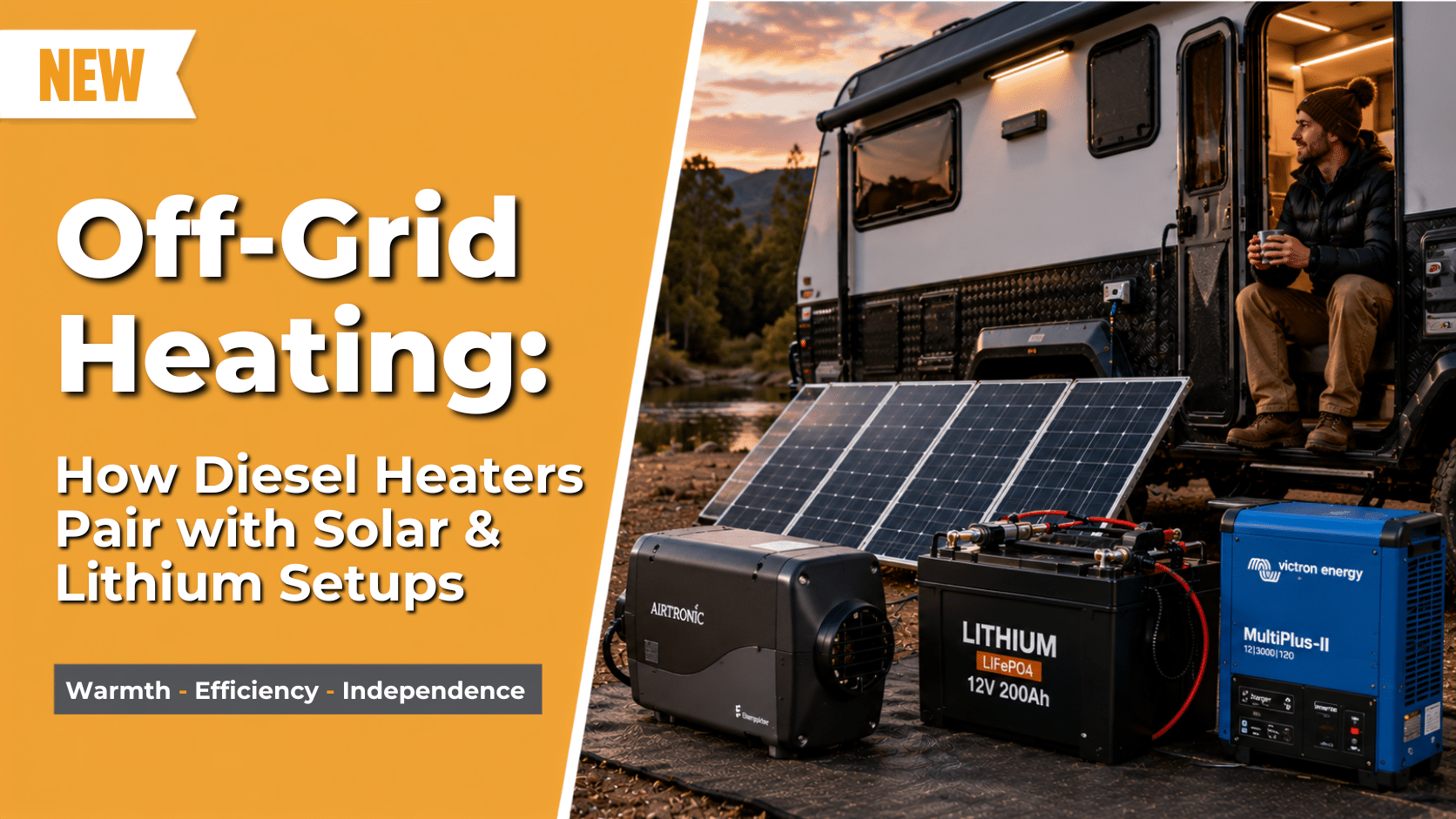
One of the biggest myths in off-grid caravanning is that going off-grid means going without proper heating. Plenty of travellers assume that if they’re not plugged into mains power, their options are limited to a small electric heater that drains the battery in an hour, or simply layering up and toughing it out. Neither is true.
The reality is that diesel heaters, solar power, and lithium battery systems work together better than almost any other combination of caravan upgrades. Each system covers a gap the others leave open, and when set up correctly, the result is a caravan that stays warm overnight in genuinely cold conditions without needing a powered site, a generator running all night, or constant fuel stops. In this guide, we’ll explain how these three systems work together, why diesel heating is the standout choice for off-grid travel, and what to consider when planning or upgrading your setup.
Why Off-Grid Heating Is Different to Powered-Site Heating
When you’re plugged into 240V mains power at a caravan park, heating is simple – an electric heater or reverse-cycle air conditioner does the job, and power isn’t a concern. Off-grid, the equation changes completely. Every appliance you run draws from a finite battery bank that needs to be recharged by solar (and sometimes an alternator) during the day.
Heating is one of the most power-hungry tasks in a caravan. An electric heater can draw upwards of 1,000 to 2,000 watts continuously – a load that would exhaust even a substantial lithium battery bank within a couple of hours. For an overnight heating need that might run for six, eight, or more hours through a cold night, electric heating off batteries simply isn’t viable for most off-grid setups.
This is exactly where diesel heaters change the game.
Why Diesel Heaters Are Built for Off-Grid Travel
Diesel heaters work by burning a small amount of diesel fuel to produce heat, which is then circulated through ducting into the caravan’s living space. The fuel typically comes from a small dedicated tank or is drawn from the vehicle’s main fuel supply, meaning you’re not relying on a separate consumable like LPG bottles.
The Off-Grid Advantage
Minimal battery drain. While a diesel heater does use some 12V power – primarily for the ignition sequence, fuel pump, and circulation fan – this draw is a fraction of what an electric heater requires. A diesel heater might draw somewhere in the range of 1 to 5 amps during operation, compared to the 80-plus amps an electric heater would demand from a 12V system via an inverter.
Independent fuel source. Diesel is widely available at fuel stops across Australia, and many setups allow the heater to draw from the same tank used for towing, removing the need to carry and manage a separate fuel source.
Sustained heat output for long periods. Diesel heaters are designed to run for extended periods – including overnight – making them ideal for genuinely cold off-grid locations like high-country camps, inland winter touring, or early morning starts in cooler climates.
Low fuel consumption relative to output. For the amount of heat produced, diesel heaters are remarkably efficient, which matters when fuel efficiency directly affects how far you can travel between stops.
The Role of Solar in an Off-Grid Heating Setup
If a diesel heater handles the heat itself, what role does solar play? Solar is what keeps your battery bank topped up so the heater – along with your lighting, water pump, fridge, and other 12V systems – has the power it needs to operate, day after day, without needing to plug in.
How Solar Supports Your Heating System
Recharging the battery bank that powers the heater. Even though a diesel heater’s power draw is modest compared to electric heating, it still needs reliable 12V power to run its fan, ignition, and control board – especially over multiple nights of use. Solar panels recharge the battery bank during the day so that power is available when you need it overnight.
Reducing reliance on driving or generators to maintain charge. Without solar, your battery bank only recharges when you’re driving (via the vehicle’s alternator) or running a generator. For travellers staying multiple nights in one spot – which is often when heating is needed most – solar is what keeps the system self-sufficient.
Supporting the whole-of-van power ecosystem. Heating doesn’t operate in isolation. Your fridge, lighting, water pump, and any other 12V or inverter-based appliances are all drawing from the same battery bank. A properly sized solar system ensures the heater isn’t competing with everything else for limited power.
Why Lithium Batteries Make the Difference
Not all batteries are created equal when it comes to supporting an off-grid heating setup, and this is where lithium battery upgrades become particularly relevant.
Lithium vs Traditional Lead-Acid
Usable capacity. A traditional lead-acid battery typically shouldn’t be discharged below 50% to preserve its lifespan, effectively halving its usable capacity. Lithium batteries can be discharged much further – often to 80% or more of their rated capacity – meaning a lithium battery delivers significantly more usable power for the same physical size and weight.
Consistent voltage under load. Lead-acid batteries experience voltage drop as they discharge, which can affect the performance of sensitive electronics, including heater control boards. Lithium batteries maintain a more stable voltage across their discharge cycle, supporting more reliable heater operation overnight.
Faster recharge from solar. Lithium batteries generally accept charge more efficiently and at higher rates than lead-acid equivalents, meaning your solar system can replenish the battery bank more quickly during daylight hours – particularly valuable on shorter winter days when there are fewer sunlight hours to work with.
Weight savings. Lithium batteries are significantly lighter than lead-acid batteries of equivalent capacity, which matters for caravan payload – especially if you’re also carrying a diesel heater, fuel tank, solar panels, and associated wiring and components.
How the Three Systems Work Together
Here’s how a well-designed off-grid heating setup typically functions on a cold night, away from any powered site:
During the day, solar panels recharge the lithium battery bank, topping it up even on shorter winter days thanks to lithium’s efficient charge acceptance. As temperatures drop in the evening, the diesel heater draws a small, steady current from the battery bank to run its fan, ignition, and controls – while the actual heat comes from diesel fuel, not from the battery itself. Through the night, the heater maintains a comfortable cabin temperature for hours, drawing only a modest amount of stored power. By morning, the battery bank still has charge remaining for the fridge, lighting, and water pump – and as the sun comes up, solar begins recharging the system again, ready for the next night.
This is the key insight: diesel heaters provide the heat, while solar and lithium batteries provide the electrical “life support” that keeps the heater – and everything else – running reliably, night after night, without external power.
Planning an Off-Grid Heating Upgrade
If you’re considering adding a diesel heater, upgrading to lithium, or expanding your solar setup – or all three – a few things are worth thinking through before committing:
Battery bank sizing. Your lithium battery capacity should account for the heater’s overnight draw alongside your other 12V needs (fridge, lighting, water pump, USB charging, etc.).
Solar array sizing. Solar needs to be sized not just for summer travel, but for the shorter days and lower sun angles of the cooler months when heating demand is highest – exactly when solar input is at its lowest.
Heater placement and ducting. Diesel heater installation involves exhaust routing, fuel line placement, and ducting design – all of which affect how evenly heat is distributed through your van and how the system integrates with existing cabinetry.
System integration. Solar, lithium batteries, and a diesel heater all need to work together electrically – proper wiring, fusing, and battery management ensure each component operates safely and efficiently alongside the others.
Because these systems interact, it’s worth having them assessed and installed together by technicians experienced in off-grid caravan setups, rather than adding each component in isolation.
Get Your Off-Grid Heating Setup Sorted
At AllBrand Caravan Services in Sandgate, Brisbane, we install and service diesel heaters, solar systems, and lithium battery upgrades for caravans and motorhomes – and we can help you plan a setup where all three work together properly, whether you’re upgrading an existing van or planning ahead for your next big off-grid trip.
[Request a quote]or call us on (07) 3869 2969 to talk through your off-grid heating setup.
—
Frequently Asked Questions
Can I run a diesel heater overnight without draining my battery off-grid?
Yes, in most properly sized setups. Diesel heaters draw a relatively small amount of 12V power – typically a few amps – to run their fan, ignition, and controls, with the actual heat coming from diesel fuel rather than the battery. A correctly sized lithium battery bank, topped up by solar during the day, can comfortably support a diesel heater running overnight alongside your other essentials.
Why can’t I just use an electric heater with a big enough lithium battery?
Electric heaters draw far more power than diesel heaters – often 1,000 to 2,000 watts continuously. Even a large lithium battery bank would be significantly depleted within a couple of hours of running an electric heater, leaving little reserve for your fridge, lighting, and other needs. Diesel heating is far more power-efficient for sustained off-grid use.
How much solar do I need to support a diesel heater setup?
It depends on your overall battery bank size and total power usage, but solar sizing for off-grid heating should account for shorter daylight hours and lower sun angles during the cooler months – exactly when heating demand is highest. A technician can help size your solar array based on your specific battery capacity and appliance load.
Does upgrading to lithium batteries make a noticeable difference for running a diesel heater?
Yes. Lithium batteries offer greater usable capacity, more stable voltage under load, and faster recharging from solar compared to lead-acid batteries. This means more reliable heater operation overnight and quicker battery replenishment during the day, particularly important on shorter winter days.
Can a diesel heater run off the same fuel tank as my tow vehicle?
Many diesel heater installations are set up to draw from a dedicated small tank, though some setups can integrate with the vehicle’s main fuel supply depending on the vehicle and installation. A technician can advise on the best fuel source option for your specific vehicle and caravan combination during installation.
It’s probably one of the questions I’ve been asked more than any other over the past couple of years. “What do you think about the Chinese caravans?” Sometimes it’s followed…
If you’ve towed a caravan through Queensland – especially long stretches between Brisbane, the Sunshine Coast, or out toward the inland highways – you’re relying on one of the smallest…
Queensland touring is hard on brake systems. Between long highway runs, stop-start traffic around Brisbane, heat coming off the bitumen and coastal humidity, your brakes are working more than you…
Todd McArthur is CEO of AllBrand Caravan Services and Managing Director of McArthur Industries in Brisbane, with over 30 years of experience in the caravan and automotive industry.