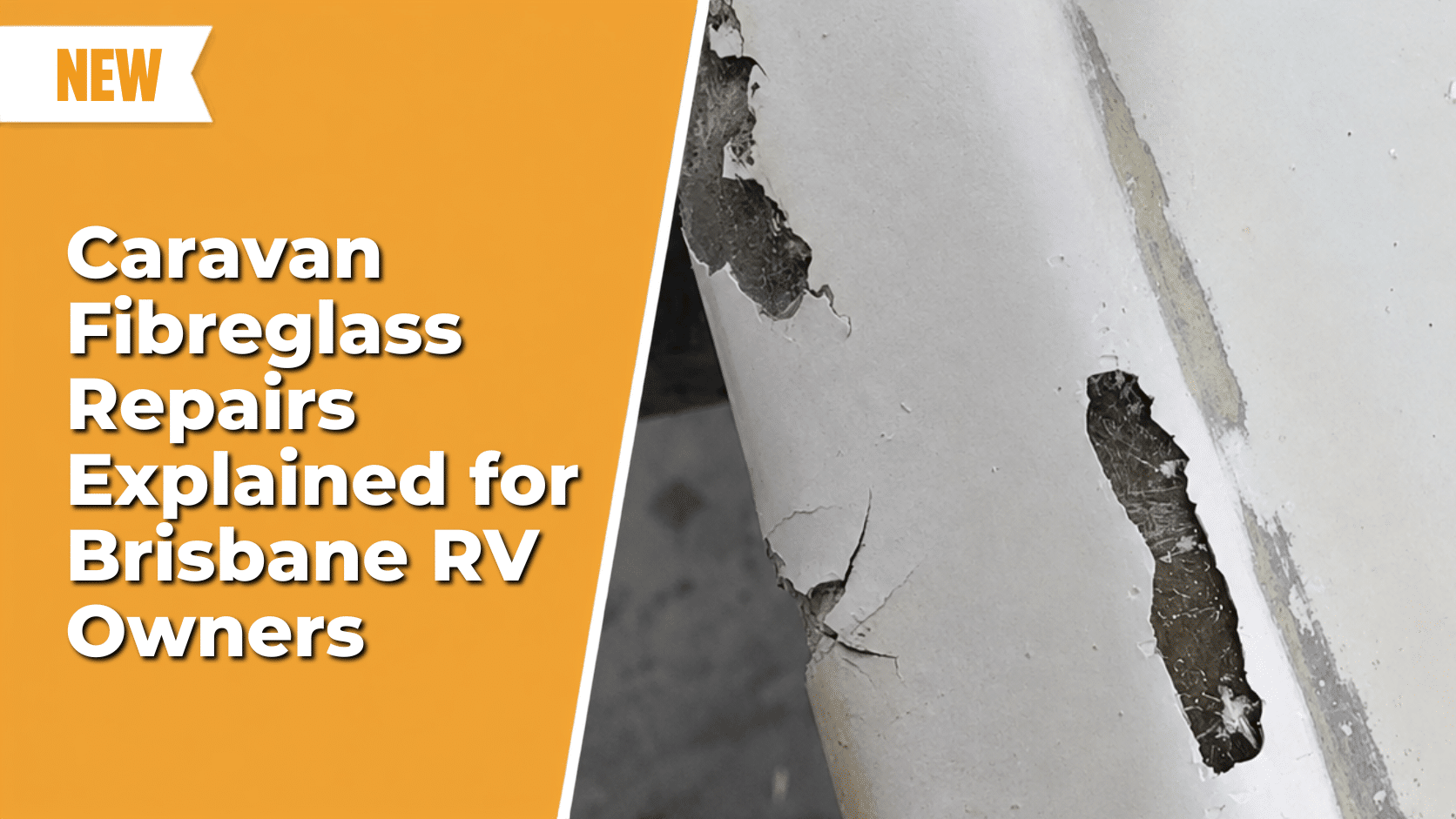
Caravan Fibreglass Repairs Explained for Brisbane RV Owners
Learn when caravan fibreglass damage needs attention, what professional repairs involve, and where Brisbane RV owners can arrange expert repairs in Sandgate.

If you’ve spent any time caravanning around Brisbane, Sandgate, or anywhere along Southeast Queensland’s coast, you’ll know the climate is unforgiving in ways you don’t always see straight away.
It’s not just the heat – it’s the humidity sitting around year-round. With average relative humidity often sitting above 60%, moisture has a constant opportunity to work its way into small weaknesses in your caravan.
And that’s where one of the most expensive hidden problems starts: caravan wall water ingress and delamination.
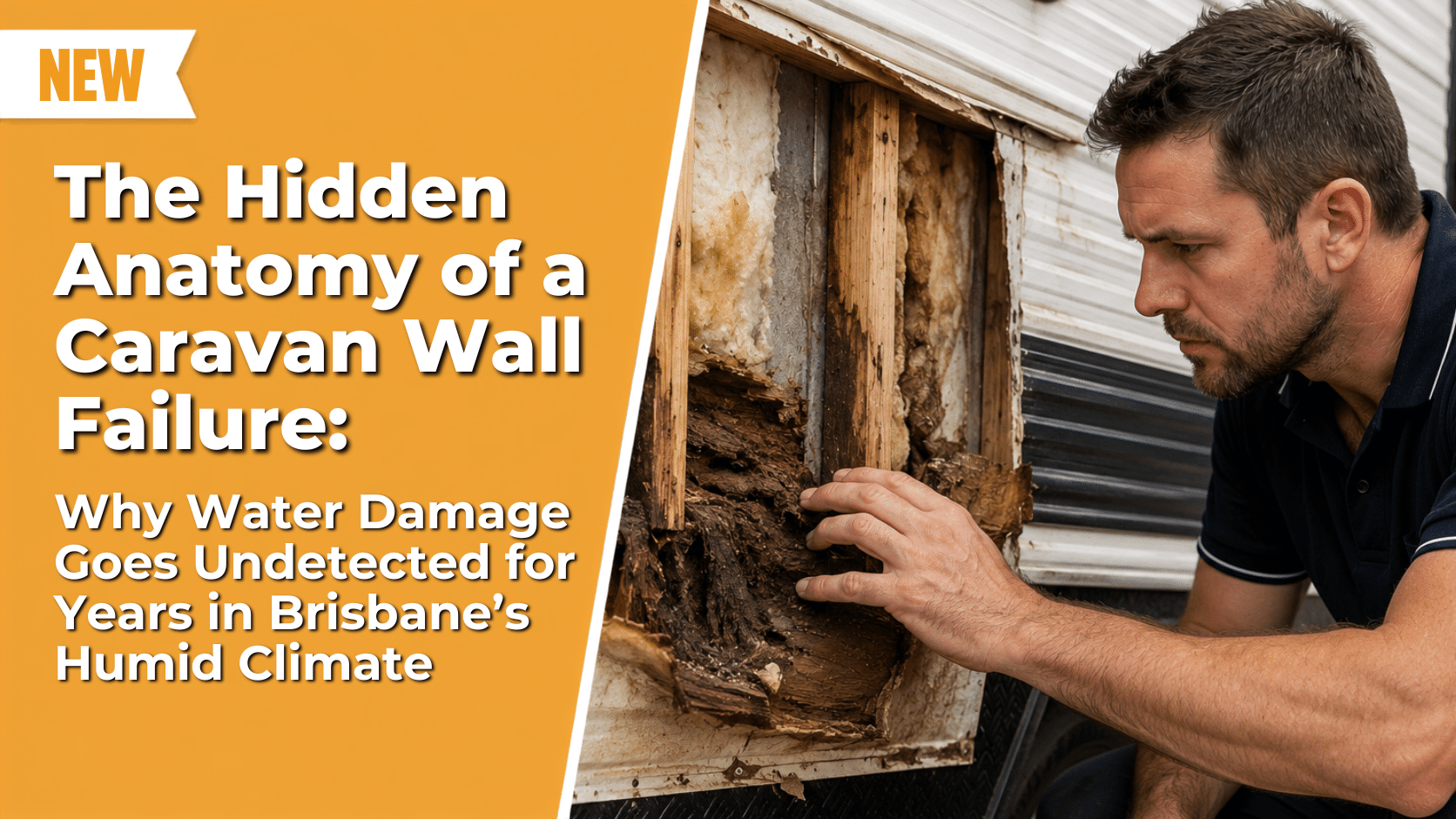
From what we see in the workshop, water damage is rarely sudden. It’s slow, quiet, and often hidden behind perfectly normal-looking panels – until the wall starts to bubble, soften, or fail structurally.
Caravan wall failure doesn’t usually start with obvious leaks.
It starts with:
Then, over time, moisture gets trapped inside the wall structure.
By the time most owners notice it, the damage has already spread through multiple layers.
We see this a lot in Brisbane – vans that look fine externally but are already structurally compromised inside the wall cavity.
To understand why water damage is so destructive, you need to know how caravan walls are built.
Most modern caravans use a three-layer sandwich construction:
These layers are bonded together to create a lightweight but strong structure.
The problem?
Once moisture enters the core, it has nowhere to escape.
That trapped moisture is what leads to:
From workshop inspections, water almost always enters through predictable locations:
Constant UV exposure and flexing slowly breaks down sealants.
Poor sealing or aged rubber gaskets allow slow seepage.
Screws and penetrations create micro-entry points.
Movement during travel opens small gaps over time.
Awnings, solar panels, antennas and racks all introduce mounting points.
Even a pinhole-sized breach is enough in Brisbane’s humidity.
This is where Southeast Queensland is unique.
With sustained humidity averaging around 63% relative humidity, moisture doesn’t just enter – it lingers.
Unlike dry climates where trapped moisture can evaporate, Brisbane’s air often:
Over time, this accelerates:
It’s a slow process – but relentless.
Water damage doesn’t happen overnight. It follows a pattern we see repeatedly in the workshop:
Stage 1: Entry (Weeks to Months)
Stage 2: Absorption (Months to 1–2 Years)
Stage 3: Adhesive Breakdown (1–3 Years)
Stage 4: Visible Delamination (3+ Years)
By Stage 4, repairs are significantly more complex and expensive.
This is where early detection matters.
Look for:
We often find owners ignore these signs because the van still “looks fine”.
Unfortunately, internal damage doesn’t show itself until later stages.
There are a few basic checks owners can do:
But here’s the limitation:
You can’t see inside the wall cavity.
That’s where professional diagnosis becomes important. In the workshop, we use:
This helps identify hidden water ingress before it becomes structural damage.
Thermal imaging is one of the most useful tools for detecting caravan water damage early.
Moisture changes how heat moves through materials. Wet areas often:
This allows us to map moisture movement inside the wall without cutting into it.
It’s especially useful in humid climates like Brisbane where surface conditions can be misleading.
Caravan wall repairs vary significantly depending on severity.
Common repair approaches include:
Cost depends on:
From what we see in Brisbane, early intervention always reduces cost dramatically.
Water damage in caravans is one of those issues that never stabilises on its own.
Once moisture enters the core:
Ignoring it usually turns a manageable repair into a major rebuild.
And in humid climates like Southeast Queensland, the progression is often faster than people expect.
A few simple habits go a long way:
This is especially important before long trips or seasonal travel.
Caravan Repairs
Caravan Water Ingress Diagnosis
Caravan Insurance Repairs
Motorhome Servicing
It’s usually caused by moisture entering the wall structure and breaking down the adhesive between layers.
Soft spots indicate internal core material has absorbed moisture and lost structural strength.
It can be very serious if left untreated, potentially affecting structural integrity and requiring panel replacement.
Costs vary widely depending on severity, from localised repairs to full panel replacement in advanced cases.
Yes, but early detection makes repairs significantly easier and less expensive.
We use Brisbane’s only water pressure testing machine to detect water damage. The machine is installed inside the RV, the van is pressurised, and a soapy solution is sprayed on the outside of the van. When bubbles appears, it’s a sign of water damage.
Regular seal maintenance and early inspections are the best prevention methods.
Caravan wall water damage is one of the most deceptive issues in caravanning. In Brisbane’s humid climate, it doesn’t announce itself loudly – it builds quietly behind the scenes until the damage becomes visible.
From what we see in the workshop, the key difference between a minor repair and a major rebuild almost always comes down to timing.
Catching water ingress early doesn’t just protect your caravan – it protects your travel plans, your safety, and your long-term costs.
📞 Call us: 07 38692969
📍 Visit us: 101 Connaught Street, Sandgate Qld 4017
📧 Email: [email protected]